

Article
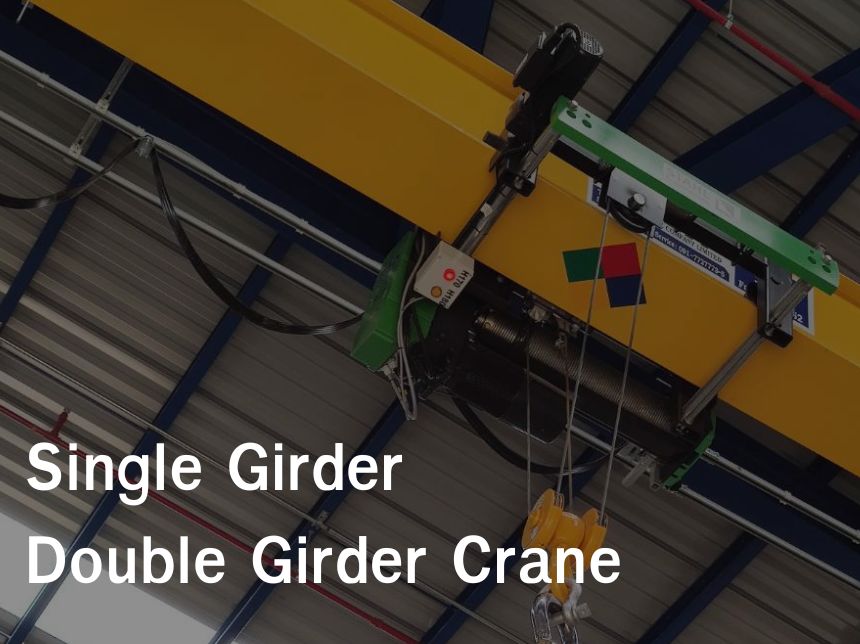
Single Girder vs Double Girder Crane — What’s the Difference?
Single Girder vs Double Girder Crane — What’s the Difference?
A Single Girder Crane has one main beam with the hoist suspended underneath. It typically supports loads from 0.5–20 tons, with a span up to 20 meters. It is more cost-effective and suitable for general industrial applications.
A Double Girder Crane has two parallel beams with the hoist running on top. It supports heavier loads from 5–500+ tons, offers a wider span, and is designed for higher duty cycles, making it ideal for heavy-duty and industrial operations.
Structural Differences
Single Girder Crane
Consists of a single girder spanning between two end carriages. The hoist is mounted on an under-running trolley, traveling beneath the beam. This design is more compact, lighter, and cost-efficient.
Double Girder Crane
Consists of two parallel girders. The hoist is mounted on a top-running trolley, traveling on top of the beams. This structure is significantly stronger and allows for higher load capacity and wider spans.
Comparison Table: Single Girder vs Double Girder
| Feature | Single Girder | Double Girder |
|---|---|---|
| Load Capacity | 0.5 – 20 tons | 5 – 500+ tons |
| Max Span | ≤ 20 m | ≤ 35+ m (up to 50+ m special) |
| Hook Height | Lower (hoist under beam) | Higher (hoist on top) |
| Duty Cycle (FEM) | M3 – M5 | M5 – M8 |
| Cabin Installation | ✗ Not available | ✓ Available |
| Price | 30–50% lower | Higher |
| Structure Weight | Lighter | Heavier |
| Maintenance | Easier (ground access) | Requires platform or cabin |
| Standards | FEM, ISO, DIN | FEM, ISO, DIN + CMAA Class D–F |
Single Girder Crane — In Detail
Advantages:
- Lower cost (less material and simpler structure)
- Lightweight (less demand on building structure)
- Low headroom (ideal for low ceiling buildings)
- Easier installation and relocation
- Simple maintenance
Disadvantages:
- Limited capacity (typically ≤ 20 tons)
- Limited span (deflection increases with longer spans)
- Lower duty cycle (not ideal for 24/7 operation)
- Lower hook height (hoist under beam reduces lifting height)
Best for:
- Assembly lines
- Maintenance workshops
- Medium-sized warehouses
- Food & pharmaceutical plants (stainless options)
- Buildings with limited structural capacity
Double Girder Crane — In Detail
Advantages:
- High load capacity (up to hundreds of tons)
- Wider span with less deflection
- High duty cycle (M6–M8, suitable for 24/7 operation)
- Greater hook height (hoist runs on top)
- Supports cabin, grab, magnet, and special equipment
- More durable in harsh environments
Disadvantages:
- Higher cost
- Heavier (requires stronger building structure)
- Requires more headroom
- More complex maintenance
Best for:
- Steel mills and foundries
- Shipyards
- Heavy fabrication plants
- Power plants and energy facilities
- Ports and terminals
- Any application requiring >20 tons or >20 m span
How to Choose — 5-Step Guide
Step 1: Define Maximum Load
Add a safety factor of 25–33% to actual load.
Example: 10 tons → choose 12.5–13.3 tons
If >20 tons → choose Double Girder
Step 2: Measure Span
- < 15 m → Single Girder is sufficient
- 15–20 m → depends on load and duty cycle
20 m → Double Girder recommended
Step 3: Evaluate Duty Cycle
- 1–4 hrs/day → M3–M4 (Single)
- 4–8 hrs/day → M4–M5 (Single or Double)
- 24/7 operation → M6–M8 (Double only)
Step 4: Check Required Hook Height
If maximum lifting height is critical → Double Girder has advantage
Step 5: Check Building Structure
Double Girder cranes are 2–3 times heavier. Structural verification is required.
Frequently Asked Questions (FAQ)
Q: Can a Single Girder Crane lift 20 tons?
A: Yes, but it depends on span. For 20 m span and 20 tons, special design is required. In many cases, Double Girder may be more practical.
Q: Can I upgrade from Single to Double Girder later?
A: Possible, but costly and complex. Runway rails and structure often need modification. Proper planning from the beginning is recommended.
Q: Can ALLA design both types?
A: Yes. ALLA provides design, manufacturing, installation, and maintenance for both Single and Double Girder cranes based on customer requirements.
Q: What is the price difference?
A: Double Girder cranes are typically 40–80% more expensive than Single Girder cranes of the same capacity due to more materials and complexity.